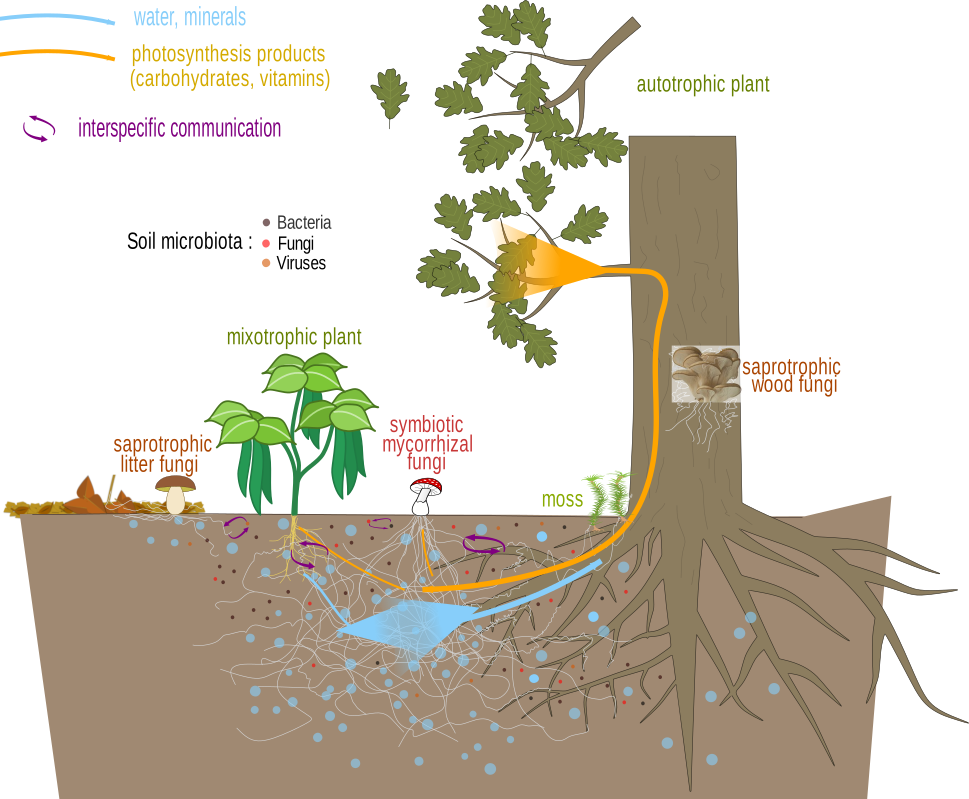
Somewhere beneath your feet, right now, something enormous is breathing.
You can't see it.
You'll never step on it and know.
But scientists just mapped it for the first time — and the numbers are almost impossible to process.
It's called the arbuscular mycorrhizal fungal network.
Microscopic threads called hyphae, spreading through soil worldwide.
They link up with roots of 70% of all plant species on the planet.
Plants feed the fungi sugar.
Fungi feed plants water, phosphorus, nitrogen.
An ancient trade deal, running for millions of years, invisible the entire time.
Published in Science, the new global map puts a length on this web.
👉 110 quadrillion kilometres.
That's nearly one billion times the distance between Earth and the Sun.
Packed into topsoil.
Everywhere. Forests. Grasslands. The farm down the road.
Researchers call it plainly:
"One of Earth's largest living structures."
This isn't just a nutrient courier service.
It's a carbon vault.
Nobody was counting this.
Until now.
Heavy fertiliser use.
Deforestation.
Soil erosion.
Urban sprawl.
Each one quietly frays this web we never see and rarely think about.
The team behind the map — including the Society for the Protection of Underground Networks — says the point isn't just wonder.
It's triage.
Now we know where this network is thickest, and where it's most at risk.
We've spent decades protecting what we can photograph — forests, reefs, wetlands.
Meanwhile, the biggest living structure on Earth was sitting under our shoes the whole time.
Maybe the next big climate fight isn't fought by looking up.
It's fought by looking down.
That's all for now!
